Predictor › Labradoodle
Labradoodle: size, coat & shedding by generation
Labrador × Poodle. High-energy and trainable; coat ranges from fleece to wool depending on generation.
Parents modelled here: Labrador Retriever × Standard Poodle. Other Poodle sizes and generations ↓
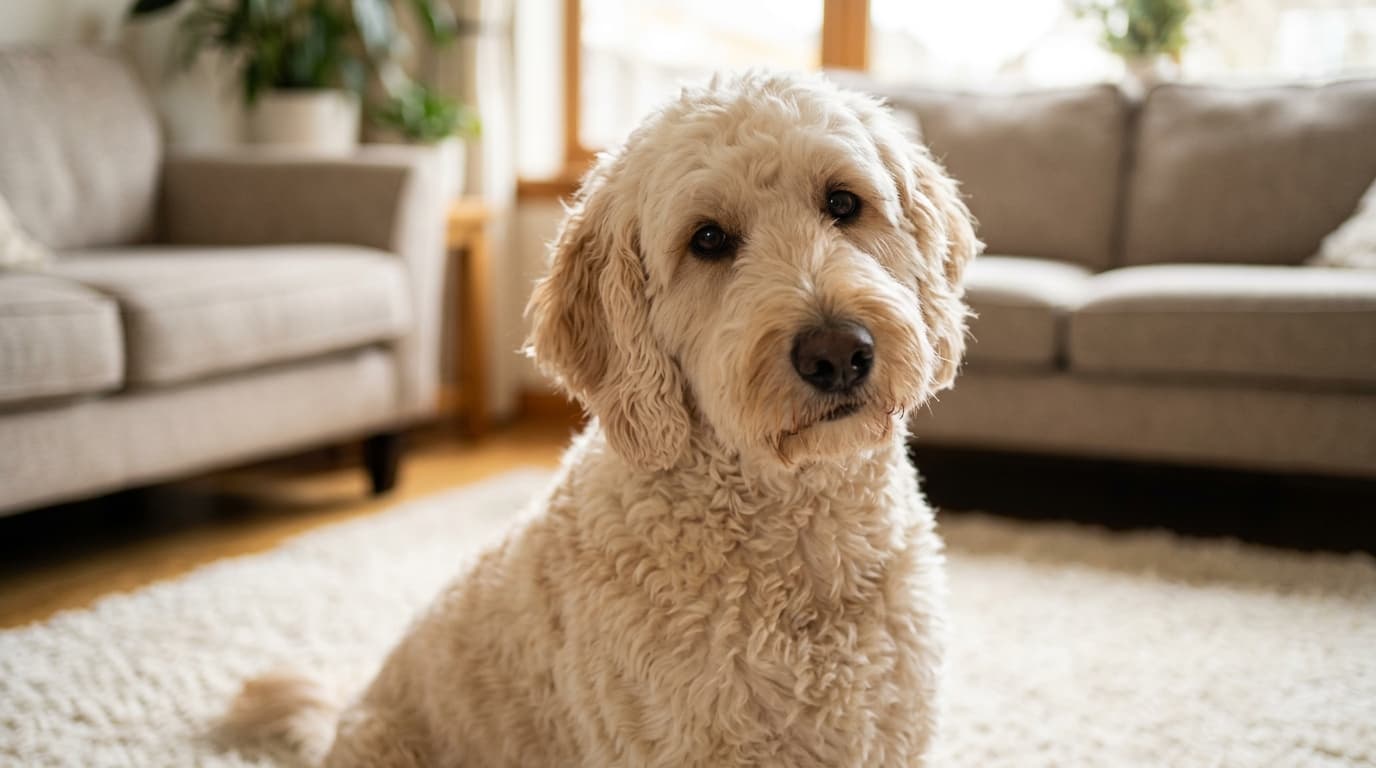
Labradoodle at a glance
Adult size
Coat type (F1)
Temperament
How big does a Labradoodle get when full grown?
An F1 Labradoodle from a Standard Poodle parent usually ends up 37–86 lb (17–39 kg) and 17–26 in tall at the shoulder. A Labrador Retriever (about 67 lb) and a Standard Poodle (about 57 lb) are close enough in weight that the generation hardly shifts the size: an F1B Labradoodle is 37–82 lb. The Poodle's size matters more than the generation. With a Miniature Poodle instead, an F1 Labradoodle is 26–57 lb; with a Medium (Moyen) Poodle, 29–71 lb.
The Labradoodle's parents side by side
| Parent | Adult weight | Height | Coat | Sheds | Energy · Train · Affection · Social (1–5) |
|---|---|---|---|---|---|
| Labrador Retriever | 55–79 lb 25–36 kg | 22–24 in | straight/flat | heavily | 5 · 5 · 5 · 5 |
| Miniature Poodle | 11–20 lb 5–9 kg | 11–15 in | curly | very little | 4 · 5 · 4 · 4 |
| Medium (Moyen) Poodle | 20–42 lb 9–19 kg | 14–18 in | curly | very little | 4 · 5 · 4 · 4 |
| Standard Poodle | 44–71 lb 20–32 kg | 18–24 in | curly | very little | 4 · 5 · 4 · 4 |
Do Labradoodles shed?
Less than a Labrador Retriever, but rarely zero. The Labrador Retriever sheds heavily, and a half-Poodle F1 Labradoodle can still shed lightly even with the furnished doodle coat, because a separate shedding gene plays a part (Hayward et al., 2016). An F1B, 75% Poodle, is the better bet for a low-shedding home. F2 is the gamble: about 1 in 4 F2 Labradoodle puppies get a flat coat and shed like the Labrador Retriever. No doodle is guaranteed non-shedding.
| Labradoodle generation | Adult weight | Curly / Wavy / Flat | Furnished coat | Size conf. |
|---|---|---|---|---|
| F1 Labrador Retriever × Standard Poodle | 37–86 lb 17–39 kg | 20% / 75% / 5% | 98% | Medium |
| F1B F1 Labradoodle × Poodle | 37–82 lb 17–37 kg | 50% / 48% / 2% | 100% | Medium-High |
| F2 F1 × F1 Labradoodle | 35–88 lb 16–40 kg | 30% / 45% / 25% | 75% | Low |
Furnished: the Labradoodle's beard-and-eyebrows coat. How the coat genes work →
What is an F1B Labradoodle?
An F1 Labradoodle bred back to a Poodle, so the puppies are about 75% Poodle and 25% Labrador Retriever. With a heavy-shedding Labrador Retriever in the mix, it's the generation to ask for if you want the least hair. Size barely moves (37–82 lb). No dog is truly hypoallergenic, F1B included.
F2B, F1BB, multigen or a cross you're not sure of? Work out any litter's generation and coat odds →
What is the Labradoodle's temperament like?
The Labrador Retriever scores higher than the Poodle on energy (5 vs 4), affection (5 vs 4) and sociability (5 vs 4). The two match on trainability. An F1 Labradoodle averages out at very high energy, very high trainability, very high affection and very high sociability. Those are averages, not promises: a Labradoodle with that much energy needs daily exercise and training, and meeting both parents tells you more than any score.
How the Labradoodle compares with all 45 doodles
- Size: the 11th heaviest of the 45 doodles we model (37–86 lb as an F1 on a Standard Poodle), between the Goldendoodle just above and the Irish Doodle just below.
- Energy: very high (5/5) on our F1 blend. No doodle here scores higher; 10 tie with the Labradoodle.
- Shedding risk: the Labrador Retriever is a heavy shedder, as is the non-Poodle parent of 18 other doodles here, such as the Goldendoodle, Irish Doodle and Shepadoodle. That puts it in the group where a flat-coated F2 pup sheds the most.
Labradoodle by size
Miniature Poodle parent · F1 26–57 lb
Medium LabradoodleMedium (Moyen) Poodle parent · F1 29–71 lb
Standard LabradoodleStandard Poodle parent · F1 37–86 lb
📈 Puppy on the way? See the Labradoodle growth chart & adult-weight calculator →
🎨 Curious about colours? See Labradoodle colors →
What health tests should a Labradoodle breeder do?
Ask for written results on both parents, not just a vet check. The Labrador Retriever club recommends 7 tests, and for a Standard Poodle the Poodle club recommends 5 (the list changes with Poodle size). Hip evaluation, eye exam by a veterinary ophthalmologist and PRA-prcd DNA test are on both lists, so ask for them on both sides: a Labradoodle can inherit the problem from either parent, and crossing breeds doesn't cancel it out.
| Labradoodle health checklist | Labrador Retriever | Miniature Poodle | Standard Poodle |
|---|---|---|---|
| Hip evaluation | ✓ | ✓ | ✓ |
| Eye exam by a veterinary ophthalmologist | ✓ | ✓ | ✓ |
| PRA-prcd DNA test | ✓ | ✓ | – |
| Elbow evaluation | ✓ | – | – |
| D locus (dilute colour) DNA test | ✓ | – | – |
| CNM (centronuclear myopathy) DNA test | ✓ | – | – |
| EIC (exercise-induced collapse) DNA test | ✓ | – | – |
| Patella evaluation | – | ✓ | – |
| NEwS DNA test | – | – | ✓ |
| Thyroid (autoimmune thyroiditis) evaluation | – | – | ✓ |
| von Willebrand disease I DNA test | – | – | ✓ |
| Life expectancy (AKC) | 11–13 yrs | 10–18 yrs | 10–18 yrs |
Sources: AKC Labrador Retriever, Miniature Poodle and Standard Poodle pages, checked 1 Nov 2026. OFA (ofa.org) lists many Labrador Retriever and Poodle results by registered name. The Medium (Moyen) Poodle isn't AKC-recognised; ask for the same tests as a Standard Poodle.
How long do Labradoodles live?
There's no study of Labradoodle lifespan, so treat exact figures with suspicion. The AKC lists 11–13 years for the Labrador Retriever and 10–18 years for the Poodle, and across dogs, smaller usually means longer-lived (Kraus et al., 2013): a Labradoodle from a Miniature Poodle may outlive one from a Standard Poodle.
Compare the Labradoodle
F1 37–86 lb vs 40–84 lb
Labradoodle vs BernedoodleF1 37–86 lb vs 49–104 lb
Labradoodle vs AussiedoodleF1 37–86 lb vs 18–51 lb
Labradoodle predictor: other sizes and generations
Know both parents' adult weights? Add them (optional)
Breeders usually list them. For an F1B or F2, enter what the actual parents weigh (the doodle and the Poodle, or both doodles).
Adult weight Confidence: Medium
37–86 lb
Height ~17–26 in · 50% Poodle
Coat type Confidence: Medium
Shedding
98%
chance of the furnished "doodle" coat, which sheds far less. Without it, a pup sheds heavily, like the Labrador Retriever. With a heavy-shedding parent, pups under about 75% Poodle can shed lightly even when furnished.
Temperament blend
- energyVery high
- trainabilityVery high
- affectionVery high
- sociabilityVery high
Crossing a different breed with a Poodle? Use the full predictor.
Doodles closest in size to the Labradoodle
- Goldendoodle (Golden Retriever × Standard Poodle): F1 40–84 lb, high energy, heavy-shedding Golden Retriever side. Labradoodle vs Goldendoodle →
- Irish Doodle (Irish Setter × Standard Poodle): F1 40–82 lb, high energy, heavy-shedding Irish Setter side.
- Boxerdoodle (Boxer × Standard Poodle): F1 40–82 lb, very high energy, moderate-shedding Boxer side.
- Shepadoodle (German Shepherd × Standard Poodle): F1 35–90 lb, very high energy, heavy-shedding German Shepherd side.
- Weimardoodle (Weimaraner × Standard Poodle): F1 37–90 lb, very high energy, moderate-shedding Weimaraner side.
- Dalmadoodle (Dalmatian × Standard Poodle): F1 33–82 lb, very high energy, heavy-shedding Dalmatian side.
See all 45 on the predictor or the growth chart hub.