Predictor › Huskydoodle
Huskydoodle: size, coat & shedding by generation
Siberian Husky × Poodle (a.k.a. Siberpoo). Striking, very high-energy and vocal; for active, experienced owners.
Also known as: Siberpoo · Huskypoo · Poosky
Parents modelled here: Siberian Husky × Standard Poodle. Other Poodle sizes and generations ↓
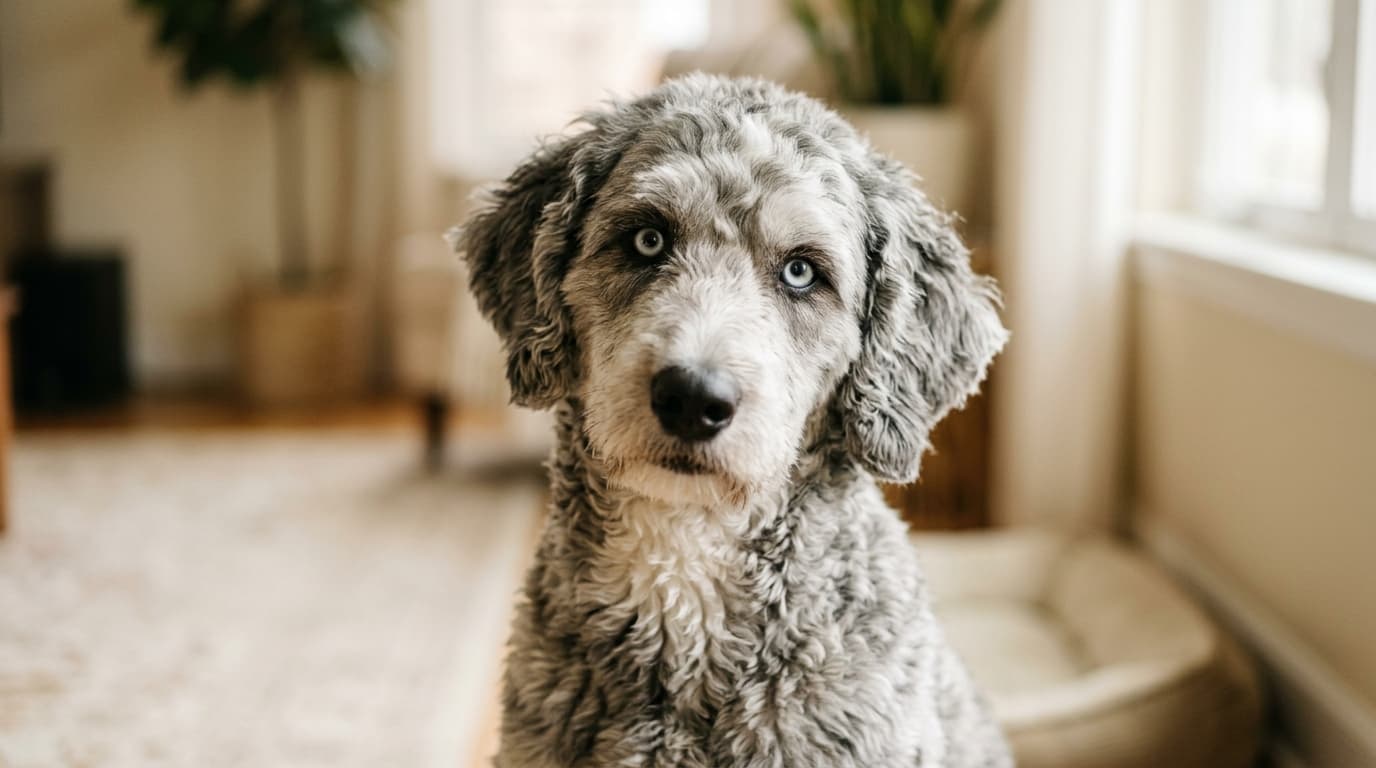
Huskydoodle at a glance
Adult size
Coat type (F1)
Temperament
How big does a Huskydoodle get when full grown?
An F1 Huskydoodle from a Standard Poodle parent usually ends up 31–75 lb (14–34 kg) and 17–26 in tall at the shoulder. A Siberian Husky (about 47 lb) and a Standard Poodle (about 57 lb) are close enough in weight that the generation hardly shifts the size: an F1B Huskydoodle is 35–75 lb. The Poodle's size matters more than the generation. With a Miniature Poodle instead, an F1 Huskydoodle is 18–46 lb.
The Huskydoodle's parents side by side
| Parent | Adult weight | Height | Coat | Sheds | Energy · Train · Affection · Social (1–5) |
|---|---|---|---|---|---|
| Siberian Husky | 35–60 lb 16–27 kg | 20–24 in | double coat | heavily | 5 · 3 · 4 · 4 |
| Miniature Poodle | 11–20 lb 5–9 kg | 11–15 in | curly | very little | 4 · 5 · 4 · 4 |
| Standard Poodle | 44–71 lb 20–32 kg | 18–24 in | curly | very little | 4 · 5 · 4 · 4 |
Do Huskydoodles shed?
Less than a Siberian Husky, but rarely zero. The Siberian Husky sheds heavily, and a half-Poodle F1 Huskydoodle can still shed lightly even with the furnished doodle coat, because a separate shedding gene plays a part (Hayward et al., 2016). An F1B, 75% Poodle, is the better bet for a low-shedding home. F2 is the gamble: about 1 in 4 F2 Huskydoodle puppies get a flat coat and shed like the Siberian Husky. No doodle is guaranteed non-shedding.
| Huskydoodle generation | Adult weight | Curly / Wavy / Flat | Furnished coat | Size conf. |
|---|---|---|---|---|
| F1 Siberian Husky × Standard Poodle | 31–75 lb 14–34 kg | 20% / 75% / 5% | 98% | Medium |
| F1B F1 Huskydoodle × Poodle | 35–75 lb 16–34 kg | 50% / 48% / 2% | 100% | Medium-High |
| F2 F1 × F1 Huskydoodle | 29–77 lb 13–35 kg | 30% / 45% / 25% | 75% | Low |
Furnished: the Huskydoodle's beard-and-eyebrows coat. How the coat genes work →
What is an F1B Huskydoodle?
An F1 Huskydoodle bred back to a Poodle, so the puppies are about 75% Poodle and 25% Siberian Husky. With a heavy-shedding Siberian Husky in the mix, it's the generation to ask for if you want the least hair. Size barely moves (35–75 lb). No dog is truly hypoallergenic, F1B included.
F2B, F1BB, multigen or a cross you're not sure of? Work out any litter's generation and coat odds →
What is the Huskydoodle's temperament like?
The Siberian Husky scores higher than the Poodle on energy (5 vs 4). It scores lower on trainability (3 vs 5). The two match on affection and sociability. An F1 Huskydoodle averages out at very high energy, high trainability, high affection and high sociability. Those are averages, not promises: a Huskydoodle with that much energy needs daily exercise and training, and meeting both parents tells you more than any score.
How the Huskydoodle compares with all 45 doodles
- Size: the 18th heaviest of the 45 doodles we model (31–75 lb as an F1 on a Standard Poodle), between the Springerdoodle just above and the Airedoodle just below.
- Energy: very high (5/5) on our F1 blend. No doodle here scores higher; 10 tie with the Huskydoodle.
- Shedding risk: the Siberian Husky is a heavy shedder, as is the non-Poodle parent of 18 other doodles here, such as the Samoyedoodle, Dalmadoodle and Irish Doodle. That puts it in the group where a flat-coated F2 pup sheds the most.
Huskydoodle by size
Miniature Poodle parent · F1 18–46 lb
Standard HuskydoodleStandard Poodle parent · F1 31–75 lb
📈 Puppy on the way? See the Huskydoodle growth chart & adult-weight calculator →
What health tests should a Huskydoodle breeder do?
Ask for written results on both parents, not just a vet check. The Siberian Husky club recommends 4 tests, and for a Standard Poodle the Poodle club recommends 5 (the list changes with Poodle size). Hip evaluation and eye exam by a veterinary ophthalmologist are on both lists, so ask for them on both sides: a Huskydoodle can inherit the problem from either parent, and crossing breeds doesn't cancel it out.
| Huskydoodle health checklist | Siberian Husky | Miniature Poodle | Standard Poodle |
|---|---|---|---|
| Hip evaluation | ✓ | ✓ | ✓ |
| Eye exam by a veterinary ophthalmologist | ✓ | ✓ | ✓ |
| SPS1 (Shaking Puppy Syndrome) DNA test | ✓ | – | – |
| SHPN1 (polyneuropathy) DNA test | ✓ | – | – |
| Patella evaluation | – | ✓ | – |
| PRA-prcd DNA test | – | ✓ | – |
| NEwS DNA test | – | – | ✓ |
| Thyroid (autoimmune thyroiditis) evaluation | – | – | ✓ |
| von Willebrand disease I DNA test | – | – | ✓ |
| Life expectancy (AKC) | 12–14 yrs | 10–18 yrs | 10–18 yrs |
Sources: AKC Siberian Husky, Miniature Poodle and Standard Poodle pages, checked 1 Nov 2026. OFA (ofa.org) lists many Siberian Husky and Poodle results by registered name.
How long do Huskydoodles live?
No study has measured Huskydoodle lifespan, so be wary of anyone quoting an exact figure. Both parents are long-lived by AKC figures: 12–14 years for the Siberian Husky, 10–18 years for the Poodle. Smaller dogs tend to outlive bigger ones (Kraus et al., 2013), so a Huskydoodle from a Miniature Poodle may outlast one from a Standard Poodle.
More Huskydoodle questions
What else is a Huskydoodle called?
Siberpoo, Huskypoo and Poosky: all names for the same Siberian Husky × Poodle cross. Breeders choose the name, not the genes, so compare Huskydoodle litters on the parents and their health results rather than the label.
Are Huskydoodles good for first-time owners?
Usually not the easiest first dog. Both parents are high-energy and the Husky side adds independence and a lot of "talking" (howls and woo-woos). They suit active owners who can give 1–2 hours of real exercise a day plus training. If you want a calmer first doodle, look at a Cavapoo or a Bernedoodle instead.
Do Huskydoodles have blue eyes?
Some do. Blue eyes are common in Siberian Huskies and can carry into the cross, but many Huskydoodles have brown or amber eyes, and some have one of each (heterochromia). No breeder can guarantee eye colour in a litter.
What is a Husky Doodle?
A Husky Doodle (Huskydoodle, Siberpoo) is a Siberian Husky crossed with a Poodle. With a Standard Poodle parent an F1 usually grows to about 31–75 lb; with a Miniature Poodle, about 18–46 lb. It isn't a recognised breed, so size, coat and colour vary more than in either parent, especially in F2 litters.
Compare the Huskydoodle
F1 31–75 lb vs 40–84 lb
Huskydoodle vs AussiedoodleF1 31–75 lb vs 18–51 lb
Huskydoodle predictor: other sizes and generations
Know both parents' adult weights? Add them (optional)
Breeders usually list them. For an F1B or F2, enter what the actual parents weigh (the doodle and the Poodle, or both doodles).
Adult weight Confidence: Medium
31–75 lb
Height ~17–26 in · 50% Poodle
Coat type Confidence: Medium
Shedding
98%
chance of the furnished "doodle" coat, which sheds far less. Without it, a pup sheds heavily, like the Siberian Husky. With a heavy-shedding parent, pups under about 75% Poodle can shed lightly even when furnished.
Temperament blend
- energyVery high
- trainabilityHigh
- affectionHigh
- sociabilityHigh
Crossing a different breed with a Poodle? Use the full predictor.
Doodles closest in size to the Huskydoodle
- Springerdoodle (English Springer Spaniel × Standard Poodle): F1 33–73 lb, very high energy, moderate-shedding English Springer Spaniel side.
- Airedoodle (Airedale Terrier × Standard Poodle): F1 33–73 lb, high energy, light-shedding Airedale Terrier side.
- Samoyedoodle (Samoyed × Standard Poodle): F1 31–77 lb, high energy, heavy-shedding Samoyed side.
- Vizsladoodle (Vizsla × Standard Poodle): F1 33–79 lb, very high energy, moderate-shedding Vizsla side.
- Dalmadoodle (Dalmatian × Standard Poodle): F1 33–82 lb, very high energy, heavy-shedding Dalmatian side.
- Irish Doodle (Irish Setter × Standard Poodle): F1 40–82 lb, high energy, heavy-shedding Irish Setter side.
See all 45 on the predictor or the growth chart hub.